


Mitrophics™ Honey Eczema Cream By Dermaphics
Mitrophics™ Honey Eczema Cream By Dermaphics
2025 #1 Mama Created Eczema Cream
POWERED by Medical Grade Honey + Colloidal Oatmeal
Works when nothing else has
Kills the bacteria that keeps flares coming back
Finally see your baby's real skin return
Couldn't load pickup availability
- Afterpay payment method
- American express payment method
- Apple pay payment method
- Visa payment method
- Master payment method
- Bitcoin payment method
- Facebook pay payment method

Mitrophics™ Honey Eczema Cream By Dermaphics
How long before I see results?
How long before I see results?
Most moms notice calmer, less red skin within 5–12 days of consistent use.
For deeper flare-ups, it can take a bit longer, but it keeps improving the more you use it.
Will this work on darker skin tones?
Will this work on darker skin tones?
Yes — and it won't leave a white cast like many other creams.
Mitrophics absorbs quickly and cleanly into all skin tones.
Many of our customers are parents of Black and brown babies who were frustrated that other products weren't formulated with their children's skin in mind.
How is this different from other eczema creams?
How is this different from other eczema creams?
Most eczema creams — even the expensive ones — are just moisturizers. They sit on top of the skin and may calm things temporarily, but they can't reach what's really causing the problem.
Up to 90% of eczema patches have staph aureus bacteria living inside the broken skin. This bacteria causes more irritation, more itching, and more damage — creating an endless cycle where nothing works for more than a day or two.
Mitrophics is different because it uses medical grade honey — the kind hospitals use for wound care — which kills staph aureus on contact.
Combined with colloidal oatmeal (the only FDA-recognized ingredient for eczema) and beeswax to seal and protect, it addresses the root cause, not just the surface.
Can it be used near the eyes or eyelids?
Can it be used near the eyes or eyelids?
Yes. Mitrophics is gentle enough to be used on delicate areas like the face, including around the eyes and eyelids.
It's made without steroids, harsh preservatives, or strong fragrances — which is especially important for sensitive facial skin. Many parents use it on the cheeks, eyelids, neck folds, and behind the ears where eczema commonly shows up.
We recommend applying a thin layer and avoiding direct contact inside the eyes.
If your baby has extremely irritated or broken skin around the eyes, start with a small amount and monitor how their skin responds.
What if it makes my baby's eczema worse?
What if it makes my baby's eczema worse?
We get it — you've probably had a cream sting, irritate, or make things worse before. That's devastating.
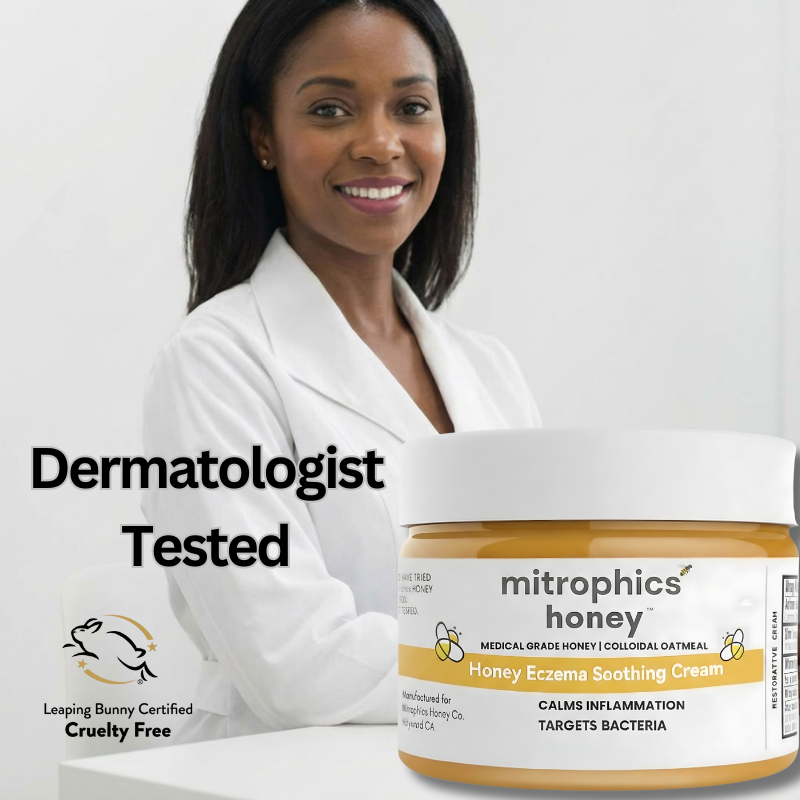
Mitrophics is formulated specifically for the most sensitive, reactive skin. It's dermatologist-tested, free from fragrances and harsh chemicals, and absorbs quickly without stinging.
Most parents notice their baby doesn't fight them during application.
If you're nervous, do a patch test on a small area first. And remember: our 60-day guarantee means if it doesn't work or causes any reaction, you get a full refund. Zero risk.
Is it safe for newborns?
Is it safe for newborns?
Yes — Mitrophics is free from essential oils, fragrances, steroids, and harsh preservatives, making it safe for newborns and young babies.
Many parents start using it as early as 2–3 months old when eczema first appears.
If your newborn's skin is extremely raw or broken, we recommend doing a small patch test first and applying a thin layer. The gentle formula is designed not to sting — even on open, weeping patches.
What about botulism?
What about botulism?
This is a great question — and one we take very seriously.
Botulism is associated with ingesting raw honey, not using medical grade honey topically on the skin. Mitrophics is not a food product and is applied externally only.
The honey used in Mitrophics is medical grade and processed specifically for topical skincare, meaning it’s purified and safe for skin use — including on babies. It does not carry the same risks associated with consuming honey.
We always recommend using Mitrophics as directed, for external use only, and keeping it out of reach of children — just like any skincare product.


Hear It Straight From Our Customers
-

“The ONLY thing that worked.”
After trying a few creams with no real change, this was the first one that actually helped calm my baby’s skin. It took a few days to see results, and the scent isn't even bad, but overall it’s worked well for us.
-

“Her skin feels softer.”
We noticed her skin becoming softer and smoother after using this regularly. It absorbs well and is easy to apply. I do wish the jar was slightly bigger, but I’m happy with the results.
-

“Her skin feels different — softer, smoother.”
Our son’s skin was in a bad state when we started using this. It wasn’t an instant fix, but with consistent use the redness and dryness improved. We’re really glad we found it.
-

“Finally… real relief!”
At first I wasn’t sure, but after about a week of regular use, I saw a noticeable improvement in my baby’s skin. The scent isn’t my favourite, but the results have been worth it.


Dermaphics vs. Others
See why Dermaphics works where other creams fail.

|
Others | |
|---|---|---|
| Target Root Cause | ||
| Steroid-Free Relief | ||
| Fast Absorbing Formula | ||
| Works On Severe Cases | ||
| Safe For Newborns |
94%
94% said their baby’s skin looked calmer and less irritated within the first week.
87%
87% reported fewer night wakings from itching, helping their little one sleep more peacefully.
89%
89% noticed less redness and rubbing within 2 weeks of consistent use.
90%
90% saw healthier-looking, more hydrated skin after 4 weeks.
3%
Only 3% requested a return or exchange — showing exceptionally high satisfaction.
These results are based on real customer feedback and ongoing user surveys.
Frequently Asked Questions
What is medical grade honey and why does it matter?
What is medical grade honey and why does it matter?
Medical grade honey is not the same as regular honey or the honey in most skincare products.
Regular honey is mostly sticky sugar with weak antibacterial properties. Medical grade honey is processed to have a specific, verified level of antibacterial strength — strong enough that hospitals use it for wound care.
It kills staph aureus (the bacteria living in eczema patches) on contact, and the bacteria can't develop resistance to it like it can with antibiotics.
That's why it works when other treatments stop working.
Is it sticky like other honey creams?
Is it sticky like other honey creams?
No — that's one of the first things parents notice.
Unlike other honey-based products that leave a thick, sticky residue, Mitrophics absorbs into the skin in about 30 seconds. You can put pajamas on right after without them sticking to the cream.
It's lightweight, smooth, and doesn't leave a white cast on darker skin tones.
Does it sting when you apply it?
Does it sting when you apply it?
No. Most parents are surprised that their baby doesn't cry or fight during application — even on raw, broken skin.
The formula is specifically designed to be gentle and non-irritating.
Many parents tell us it's the first cream their baby has actually tolerated calmly.
How quickly will I see results?
How quickly will I see results?
Every baby is different, but here's what most parents report:
Night 1: Reduced scratching, calmer sleep
Days 3–5: Weeping and oozing stops, redness calms down
Week 2: Patches begin closing, real skin starts returning
Week 3: Significant clearing, soft skin coming back
If your baby's eczema is severe, you may see the most dramatic changes. Mild cases often clear even faster.
Will the eczema come back after I stop using it?
Will the eczema come back after I stop using it?
Once the bacteria is cleared and the skin barrier has healed, many parents find they barely need to use it anymore.
Some keep a jar on hand for occasional flare-ups (which become much less frequent), but the endless daily cycle of creams usually stops.
You're not managing symptoms forever — you're actually letting the skin heal.
I've already tried everything. Why would this be different?
I've already tried everything. Why would this be different?
We hear this all the time — and we get it. You've probably spent hundreds on creams that promised results and delivered nothing.
Here's the difference: most creams you've tried are moisturizers. They can't kill bacteria. So no matter how good they are at hydrating, they can't break the cycle.
Mitrophics uses medical grade honey to kill the staph aureus bacteria that's actually keeping the eczema inflamed.
That's why it works when moisturizers — even prescription ones — don't.
We've been using steroids. Is this a replacement?
We've been using steroids. Is this a replacement?
Many parents come to Mitrophics because they're stuck in the steroid cycle — it works for a few days, then the flare comes back worse.
That happens because steroids reduce inflammation but don't kill the bacteria underneath. Once the steroid wears off, the bacteria is still there, triggering another flare.
Mitrophics targets the bacteria directly, which is why many parents are able to break the steroid cycle.
We always recommend talking to your pediatrician about tapering off steroids if that's your goal.


